
About This Game
0
Login to like
0
Login to like
What is Caesar Ruler Of Rome? Caesar Ruler Of Rome is a Simulation browser game you can play instantly online with no downloads. Experience realistic simulation and management gameplay.
CAESAR: Ruler of Rome
An Immersive First-Person Historical Simulation
Core Concept
An alternate history game set in 44 BC where you play as Julius Caesar, having survived the Ides of March. You rule Rome from a first-person perspective in a fully 3D procedurally generated world, making political, judicial, economic, and military decisions that shape the fate of the empire.
Game World
Fully offline 3D sandbox built with Three.js/WebGL
Detailed locations: Imperial Palace with marble throne room, Palatine Gardens, Roman streets and districts, the Arena, execution courtyard, and the broader city of Rome
Procedurally generated: Character meshes, faces, textures, and environments created by code at runtime
Dynamic day/night cycle with weather systems, lighting effects, and atmospheric elements
No external dependencies: Runs entirely offline from local files
Gameplay Systems
Justice & Court
Receive accused citizens brought before your throne by guards
Review evidence for crimes (theft, treason, corruption, assault)
Commission investigations (costs 50 denarii) to reveal the truth
Pass judgment with multiple sentencing options:
Merciful: Release, warning, restitution, fines
Severe: Prison, labor, flogging, whipping
Capital: Execution, crucifixion, exile, arena combat
Unjust sentences breed resentment and destabilize Rome
Watch executions carried out in the courtyard with detailed animations
Political Management
Manage approval, stability, senate loyalty, and fear metrics
Provincial governance: Monitor loyalty across Rome's provinces
Official management: Audit corrupt officials or replace them
Address the Senate to strengthen political bonds
Balance taxation (0-30%) affecting income and public opinion
Face political risk: High dissatisfaction leads to instability
Economy
Manage gold and grain reserves
Commission infrastructure projects:
Roads (800 denarii, +5 approval, +6 stability)
Granaries (600 denarii, +200 grain storage)
Aqueducts (1000 denarii, +10 approval, visual fountain effect)
Distribute grain relief to feed hungry citizens
Balance tax income against military upkeep and corruption losses
Daily economic cycle with automatic income, expenses, and harvests
Military & Battles
Command legions with strength tracking
Engage in military campaigns against various enemies
Provincial wars to restore loyalty or expand influence
Strategic resource management (upkeep costs based on legion strength)
Arena Games
Host gladiatorial events (250 denarii):
Gladiator duels
Lion exhibitions
Tiger fights
Grant mercy or condemn defeated fighters
Affects approval and fear based on your decision
Watch animated combat between fighters in the arena
Legal System
Enact and modify laws affecting various aspects of Roman life
Research system with scholars advancing knowledge
Scribes maintain records of your reign
Memory system: NPCs remember your actions and their consequences
Character System
Detailed character models with:
Procedurally generated faces using bundled texture assets
Articulated bodies (knees, elbows, fingers, feet)
Gender-specific clothing and proportions
Roman equipment (togas, armor, sandals)
Facial expressions and animations
NPC AI with memory, daily routines, and reactions
Roman citizens populating the city with individual identities
Court officials, guards, scholars, and scribes
Punishment & Execution Systems
Detailed execution mechanics:
Crucifixion with guard escorts, cross preparation, and restraints
Beheading with axe impact and physics
Flogging and whipping
Execution courtyard with crosses and execution block
Scheduled punishments carried out over time
Guards escort prisoners through procedural sequences
Player Experience
Controls
WASD: Move through Rome
Mouse: Look around (captured during gameplay)
E: Interact, speak, sit/rise from throne, open sentence menus
F: Open command menu
J: Open justice/sentence menu while seated
TAB: Imperial Council (management panels)
ESC: Pause
First-Person Perspective
Walk through the palace, courtyard, streets, and city
Sit on the imperial throne to receive audiences
Approach NPCs to interact
Witness executions firsthand in the courtyard
UI Elements
Resource display: Gold, grain, approval, stability, senate, fear
Location and date tracking
Compass and crosshair
Contextual interaction prompts
Court status indicators
Toast notifications for events
Dialogue subtitles with voice indicators
Progression Systems
Day/night cycle: 180-second days with 24-hour time progression
Random events: Fires, provincial unrest, senate requests
Autosave system: Chronicles of your reign
Multiple save slots for different playthroughs
Research progression unlocking bonuses
Infrastructure development with lasting effects
Audio
Voice system with character-specific speech indicators
Ambient music and sound effects
Contextual audio for different areas and events
Technical Features
Procedural mesh generation: Columns, arches, walls, furniture, characters
Procedural texture system: Marble, gold, wood, cloth materials
Physics system for character movement and collisions
Pathfinding AI for NPC navigation
Animation system for characters (walking, kneeling, arm movements)
Weather effects: Rain, clouds, atmospheric changes
Dynamic lighting: Braziers, torches, ambient light
Performance optimization: 30/60 FPS options, optimized meshes
Themes & Setting
Historical violence and adult themes (rated for mature audiences)
Fictional alternate history exploring "what if Caesar survived"
Moral complexity: Balance mercy vs. authority, justice vs. expediency
Roman grandeur: SPQR (Senate and People of Rome), Latin inscriptions, period-accurate architecture
Game Philosophy
Entirely offline sandbox with no external servers
Player agency: Your decisions shape Rome's fate
Consequences matter: NPCs remember, metrics shift, events cascade
Immersive simulation: First-person presence in ancient Rome
Historical atmosphere balanced with gameplay accessibility
This is a deeply ambitious historical simulation that combines first-person exploration, political management, judicial decision-making, and moral complexity in an offline 3D Roman world. The game emphasizes consequence, atmosphere, and player choice within a procedurally generated but historically inspired setting.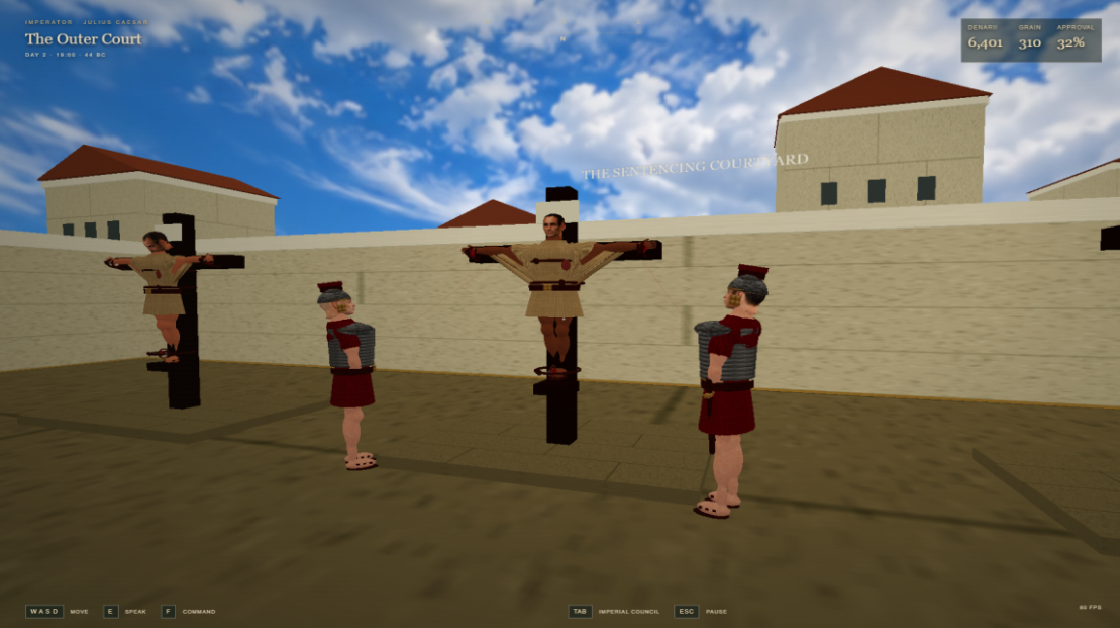
Reviews and Comments

Random Games
View All


Lumberjack
Choose between the power to heal or the power to do more damage. Survive the winter and defeat the ogre boss to win. A lumberjack with his handy axe....
2
1,008


Account Hacker
Account Hacker: Rogue Login is a dark comedy social media sabotage simulation game...
1
180

 Mobile
RedStorm Adventure!
This game includes 10 levels and 50 sets of network cabling and installation course questions. The game questions are in BM (Bahasa Malaysia)....
1
399



Xenother Cards
This is a strategy card game I developed independently. Its core gameplay combines single-player tower climbing with a roguelike overworld map, focusing on card...
4
86







·

Javascript is required to use this site.
Free games for your website WordPress Game Plugin
Publish Game iDev Token Game Database
RSS Feed RSS Feed (With Embed Code)
 Dev Coin Stats Game Stats Post Stats Member Stats Site Stats
Indie Games No Download
|
Games to Play at Work
|
Instant Play Games
|
Indie Games Platform
|
Hidden Indie Games
© 2026 iDev.Games. All rights reserved.
This site uses functional cookies for login and preferences. We also use Cloudflare (security) and PayPal (payments). By using this site, you consent to our use of cookies.
Learn more
Privacy Policy
|
Terms of Service
© 2026 iDev.Games. All rights reserved.